
Disclaimer: This article is not financial advice. Last updated August 2021.
Don't have time to read all this?
This is a long article so here's the TL;DR:
The best place to buy Bitcoin in NZ is Sywftx. Lowest fees and prices, awesome service and a registered NZ financial services provider. Click here to open a free account.
The safest way to store Bitcoin is the free wallet by Exodus, or if you own a lot of Bitcoin ($1,000+) then consider purchasing a hardware wallet. I recommend the Ledger Nano.
The best place to earn interest on Bitcoin is Xapo. They are a regulated bank. Sign up here and get $500 of free BTC with your first deposit.
Hey troops,
This is a question I've been getting asked a lot recently. Whenever I mention Bitcoin to people and that it's my highest returning investment (hands down!) they always want to know how to get started themselves.
For most people I just point them to a major exchange like Binance, which is super established and easy. You can buy Bitcoin with your credit card (which I have done, and it works great).
However, things are a little more complicated for us Kiwis. Big exchanges like Binance are not easy to use for NZD deposits.
The good news is, there are options for us to buy Bitcoin in NZ, and I have used several. In this guide I'm going to break down the best options for Kiwis to buy Bitcoin in NZ safely and fairly, so you can start adding some Bitcoin to your investment portfolio.
Contents of this guide:
- What is Bitcoin?
- How does Bitcoin affect you and I?
- What's the best place to buy Bitcoin in NZ?
- How to store Bitcoin safely
- How to earn interest on your Bitcoin
- More Bitcoin tips
What is Bitcoin, exactly?
Before you buy Bitcoin, you should know what it is. I will try to spend the next five minutes explaining this as simply as possible (of course, feel free to skip this part if you're well versed already).
Bitcoin is a currency. Think of it as the currency of the internet. It is something you can spend, like when you buy something, or save, like when you put money in the bank. But the intended purpose of Bitcoin goes a bit wider than that.
Here are a few concepts:
Bitcoin is a global currency. It is not restricted by class, citizenship or geography. It can be sent to and received by any person, anywhere in the world. It is not controlled by any bank, government, company or person. This means, like the internet, it cannot be shut down at any central point.
When people say Bitcoin is decentralised and autonomous, this is what they mean.
Bitcoin is a digital currency. This means it does not exist in physical form. It exists only digitally. This is advantageous as digital things move much faster than physical things.
Bitcoin is a decentralised currency, as it exists only on a technology known as the blockchain. Here's the easiest way for me to explain a blockchain:
Think about your bank account at ASB. Your information is stored on the ASB servers. The only party that can alter that database is ASB.
This is great, but also flawed. Flaws in this type of system were apparent in Cyprus not too long ago, where the country was about to go bankrupt and the government simply ordered banks to give them 20% of all citizens' savings. If you had $1,000 in the bank, it got chopped to $800, to keep the government from going broke. The reason the banks could do this was because they have complete control over the citizens' money. If you're a student of history, you'll know Cyprus was not the first. This has already happened many times before.
Blockchain solves this problem by replacing centralised databases with decentralised ones. Rather than the ASB database only being held on ASB's servers, the ASB database would be held on the computer of every single ASB customer instead (like your phone, or laptop). In order for ASB to take any of your money like they did in Cyprus, every customer would need to agree, or they would need to hack every customer's laptop and change the database on each one (basically impossible).
In this system, it is the holders of the currency with the power, rather than the bank.
By being decentralised in this manner, it also means that the network can operate "peer to peer". This means that when you pay someone, instead of you giving your money to ASB, and then ASB giving your money to Fred (and taking a fee), you can just send your money directly to Fred.
This is Bitcoin: The global, decentralised, digital, peer to peer currency.
So how does this affect you and I?
Bitcoin's purpose is to be an upgrade from the current idea of money.
Imagine you need to send $10,000 to your parents overseas. Usually, you would need to go to the bank, deposit the money, pay the bank a fee to change it to a foreign currency, then pay the bank a fee to send it.
Then three days later it would arrive at your parents' bank and they would pay a bunch of fees to withdraw it before they finally can use the money.
With Bitcoin, this same process can be done in under an hour for less than a ten cents in fees. Remember - peer to peer. Just like the internet changed the way we send mail, messages, and information, Bitcoin wants to change the way we send money.
Since it's beginnings in 2009 Bitcoin is now working its way into the mainstream.
Many shops worldwide now accept Bitcoin as payment for general goods and services, and it has been made an official currency of the country El Salvador (and more will surely follow!)
Recently Argentina and Paraguay settled an international trade using Bitcoin, so it is being used in international finance by governments too.
JP Morgan's CEO said in 2017 that Bitcoin was a scam and any of the bank's traders would be fired if they were caught trading Bitcoin. By 2018, JP Morgan had put together a team of Bitcoin analysts who concluded Bitcoin did in fact have an intrinsic value of $5,000 per coin. By 2020, JP Morgan had since become the bank for several top Bitcoin exchanges. Today, JPMorgan offers Bitcoin trading to every single one of its clients. See the pattern?
Now even some of the world's most prominent billionaires, including Jack Dorsey, Paul Tudor Jones and Stan Druckenmiller and Elon Musk have said they've added Bitcoin to their portfolios, and some of the biggest companies in the world such as Square and Tesla now hold and accept Bitcoin.
All are positive trends for Bitcoin, and I encourage you to do your own research and make your own estimations of where it will go in the future.
If you're interested, you can read more of my thoughts about Bitcoin here.
What's the best place to buy Bitcoin in NZ?
When I first wrote this guide in 2017, there was one clear leader for buying Bitcoin in New Zealand and that was Independent Reserve.
The reason for this was they had the lowest rates and the lowest fees of any Bitcoin exchange available to Kiwis. My recommendation is always based on price and value - whichever service offers the best value for money always gets my vote and that is what I will recommend to you.
In 2021, Independent Reserve is still a great option and I still use them, but they are no longer my top recommendation for first time investors.
They have been toppled by a full service NZ owned and operated Bitcoin broker called Swyftx .
Best option for buying Bitcoin for Kiwis: Swyftx
Swyftx is a full service cryptocurrency broker and is almost like a New Zealand version of Coinbase. Reasons why it's great:
- Orders are filled quickly at market prices.
- Very low fees.
- Excellent customer service.
- It has a big (maybe the biggest?) selection of coins.
- NZ FSP regulated
- Services NZers and works with NZD easily
How to buy Bitcoin on Sywftx in NZ?
One reason I like Sywftx because the interface is so smooth and easy. It's literally four steps and the same as buying a pair of shoes online, and you can have your Bitcoin in literally fifteen minutes or less.
Get started: Open an Swyftx account:
First, clik here to head to their website.
On their homepage, you'll see an option to open an account:
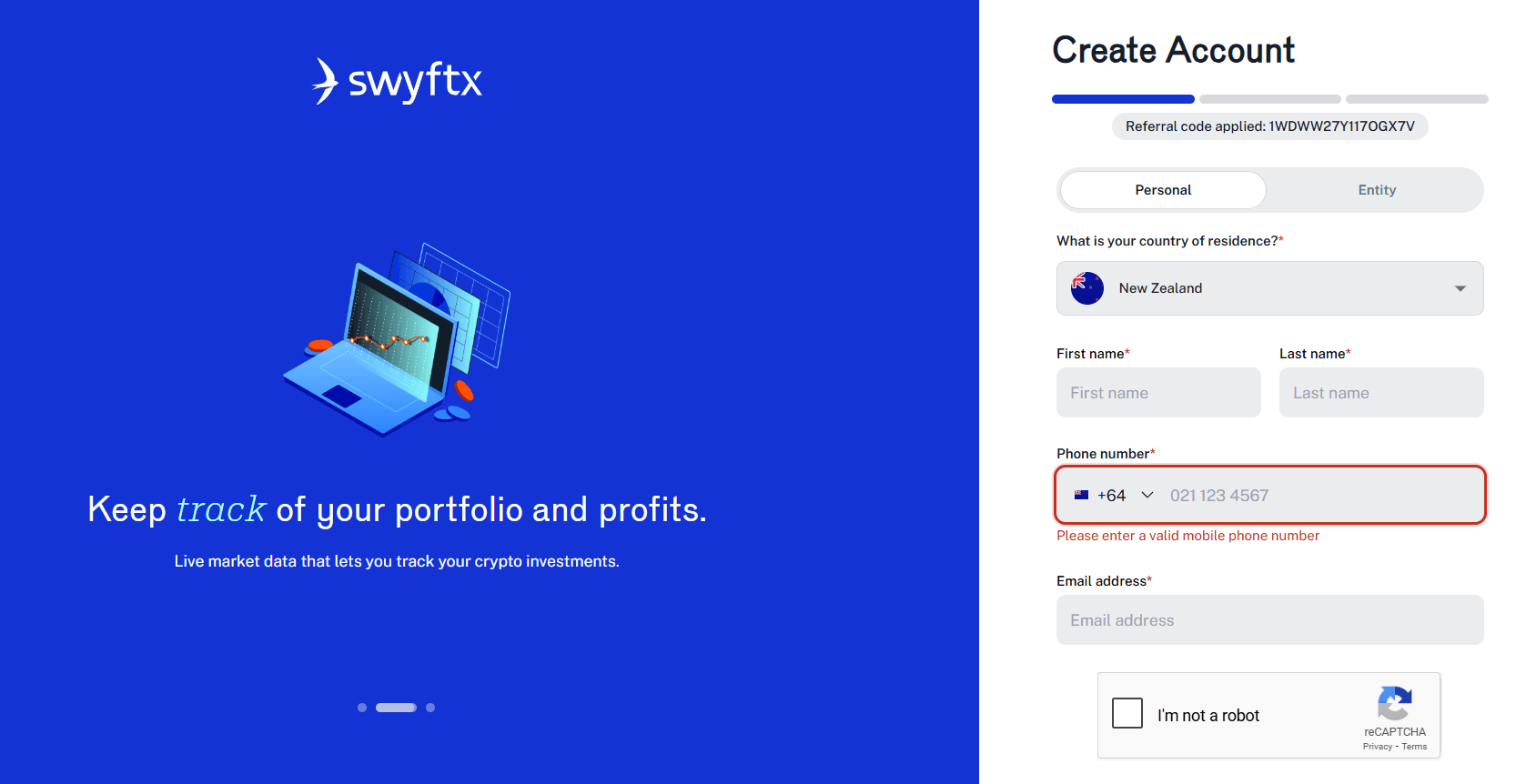
That's it! You're in.
Verifying your account:
Because Swyftx is registered as a Financial Services Provider in NZ, they need to verify your identity.
Remember, this is a good thing! Do not buy Bitcoin (or any financial service) from anyone in NZ who isn't registered. There's a good chance your money will disappear and you won't get it back.
Verifying your identity should only take a two minutes and requires a photo of your driver's license or passport, and a selfie.
Once you've done that, you're ready to buy!
Step 1: Deposit funds
Click "Transfer Funds" on the top menu.
It will bring a deposit information box like so:
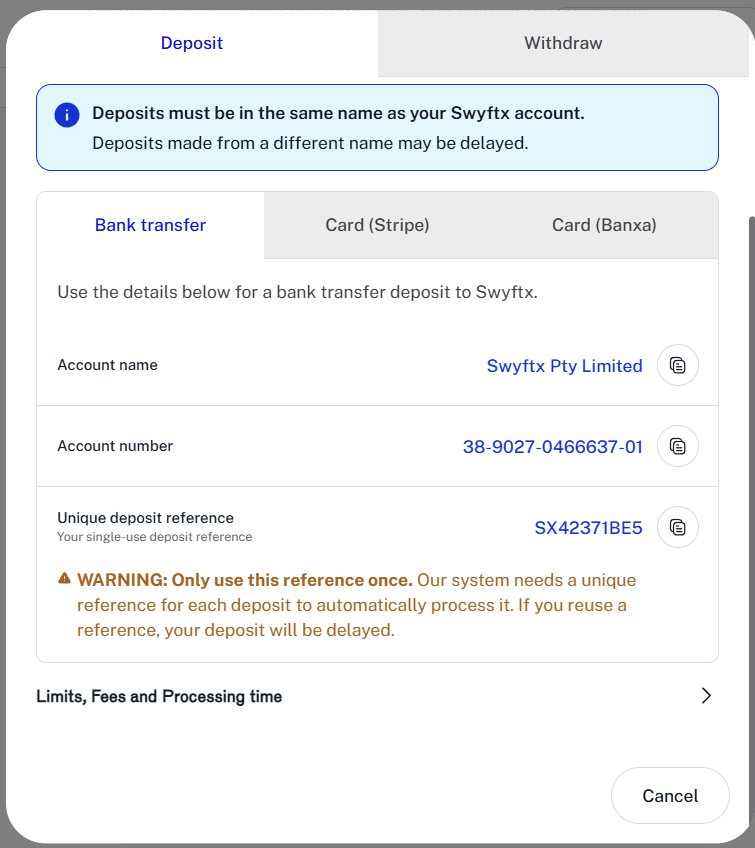
To get your reference number, click the "generate reference" button, and it will give you a reference to include with your deposit so it gets delivered to your account.
Then simply make an internet banking payment to the account number given, and you should have your funds ready in an hour or so.
Step 2: Choose your coins and quantity
For this example, I'm going to walk you through buying $100 of Bitcoin.
You should see a "Quick Buy" button on the homepage.

This should take you to a buy screen, where you can choose your coin and the amount.
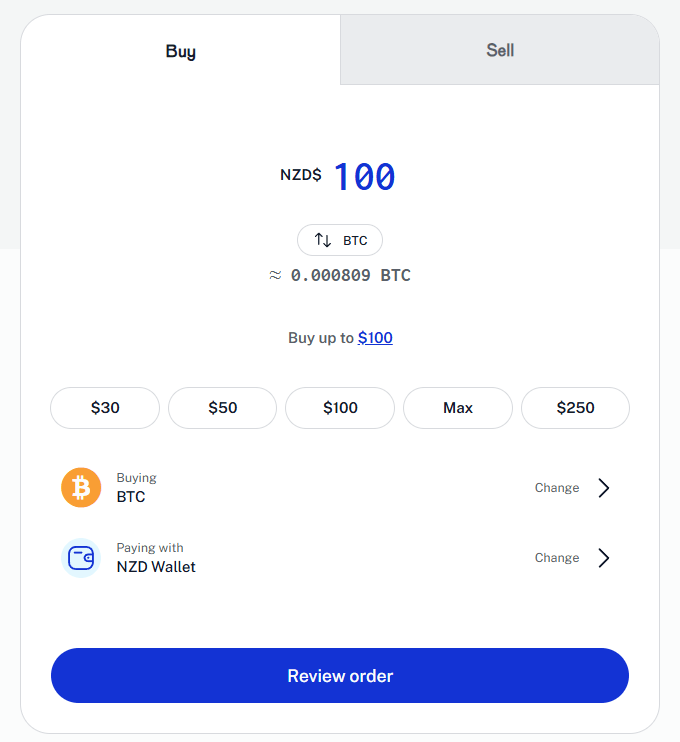
Bitcoin should be the default, so we'll leave it at that, and in the amount we'll put $100.
Of course you can choose to buy more or less, or a different coin, but we'll stick with Bitcoin for now.
Then select your source of funding as your "NZD account".
Then click buy.
THAT'S IT.
You are now the proud owner of Bitcoin!
This is actually one of the main reasons I recommend Swyftx.
They do not keep your coins in storage on their own site/servers. They actually help you set up a private wallet and help you keep your own Bitcoin.
This is the safest option and if you follow the Bitcoinsphere, you may remember Cryptopia, another NZ Bitcoin exchange got hacked in 2019 and lost around $20 million in user funds.
If people had been storing their coins in their own wallets, this wouldn't have happened.
Who should use Swyftx to buy Bitcoin?
In my opinion, Swyftx is going to be the best option for 95% of first time buyers, and for people who are new to Bitcoin.
When it comes to Bitcoin, most people are interested in buying $200 or $500 or maybe a few thousand dollars as an investment. Swyftx is absolutely perfect for this and you won't find a service better suited for it.
As you get more involved and educated about Bitcoin, you may also become interested in purchasing other cryptocurrencies such as Ethereum or Ripple XRP or Litecoin, and many others. Swyftx allows you to buy all of these as well, and has more than seventy of the most established cryptocurrencies which you can buy directly with NZD.
They're also one of the safest options and operate everything legally and above board as a registered provider, so you know you're protected by NZ law, which is not the case when dealing with overseas brokers and exchanges.
If you want to get started with Swyftx, you can open a new account by clicking here.
What's the best way to store Bitcoin in New Zealand?
Buying Bitcoin in NZ is the first hump, but what about storage?
You can leave your coins on Swyftx. This is common practice and exchanges like Swyftx have become much better at security and keeping your assets safe.
However, there are risks to this. Exchanges get hacked all the time and due to the "crypto" nature of the industry, your coins are almost never recovered.
There's the Mt Gox hack of 2014, the Bitfinex hack of 2016, the Binance hack of 2019, and even the Cryptopia hack in our very own New Zealand. It happens and it will happen again.
Therefore, if you're serious about your Bitcoin investment, have a significant dollar amount invested, and you plan on holding it for the long term, I would suggest using a Bitcoin wallet.
Most exchanges and services want to hold your coins for you, so they can keep them in private accounts in case they go under, or lend them out to traders and institutions and earn interest on them.
So, what is a Bitcoin wallet, you ask?
A wallet is a PRIVATE storage system for your Bitcoin, and it's actually how Bitcoin was originally designed to be used. This is why you might hear the phrase "Be Your Own Bank" in Bitcoin circles.
A wall operates sorta like an online bank account.
It contains two keys: one public and one private.
The public key is what you give to someone so they can send you Bitcoin. If you sold a donkey for Bitcoin, you would give the buyer your public key, and he would pay you by sending Bitcoin to that address. Think of it like your Bitcoin bank account number.
The private key is something you keep secret. Think of it like your Bitcoin internet banking password. The private key is what allows you to send Bitcoin from your wallet to somebody else. Never share your private key with anyone, ever.
Now, as for the wallets themselves. There are two main types of wallet. There are hardware wallets and software wallets.
Software wallets
Software wallets are free and are generated on your computer or mobile phone.
Think of a software wallet like the wallet you carry around in your pocket each day. It's good for storing a little bit of cash, but not for thousands and thousands of dollars.
It's the same for Bitcoin.
If you plan on buying and selling Bitcoin regularly or actually using it to pay for things, a software wallet can be a good choice for keeping a little Bitcoin that's easy for you to access each day.
Hardware wallets
A hardware wallet is more like a safe in your basement.
It's a physical device (looks like a USB drive) that you can keep in your house and use to store large amounts of digital currency. Some people even lock their hardware wallets in an actual safe or a bank safety deposit box.
What's the difference?
The usual concern with a software wallet is the private key is generated on a computer or phone and therefore can never really be considered 1,000% safe. Obviously it depends on how clean your computer is, and if you generated it offline etc etc. Remember, if someone has your private key, they have full access to your Bitcoin.
A hardware wallet is considered much safer because the private key is generated completely offline, inside the device itself, and never even touches the internet. That's why it's always recommended to store large amounts of Bitcoin on a hardware wallet.
In reality, if you only have a few hundred dollars in Bitcoin, a software wallet will probably be fine. If you have thousands and thousands of dollars in Bitcoin, you probably want to invest in a hardware wallet.
What do I use?
I do not currently use a software wallet. I store some of my coins on a hardware wallet, and have a small amount of coins stored on Independent Reserve in case I want to sell some.
The hardware wallet I use is the Ledger Nano S.

It's one of the most highly recommended in the community and is super easy to use. It also allows you to store Ethereum, Litecoin and about 30 other major cryptocurrencies, along with your Bitcoin. You can grab one here. They ship their Bitcoin wallets worldwide, including to New Zealand.
As I said I don't use a software wallet, but if you are interested in one, I would recommend the wallet provided by Exodus. If you want help setting up an Exodus wallet, it's very simple and secure, I have a free guide you can open by clicking the blue box below.
First, download the Exodus app on your phone [Android, iOS].
Open it up and you should come to this screen:

Tap the Get Started button and swipe through the introductory messages and you'll get taken to your portfolio.
You'll see the first line in your portfolio is Bitcoin:

Tap the Bitcoin logo and you'll get taken to your Bitcoin holdings:
Obviously, it will show as zero right now (but we're going to change that!)
On the left hand side you'll see an upward arrow, which is for sending Bitcoin, and on the right hand side you'll see a downward arrow, which is for receiving.
Tap the downward arrow:

This will then show you everything you need to receive Bitcoin.
You'll see your Bitcoin address at the bottom!
It should look like a string of letters and numbers starting with bc1qvuq......

Simply copy this string of characters and paste it into EasyCrypto when they ask for your address. Also, before you place your order, double and triple check that the address is correct!
Otherwise someone else might be getting a nice surprise when your Bitcoin gets sent to them instead 😉
Also, don't forget to backup your wallet. This is hugely important. Exodus has a simple guide to backing up your wallet here. It will only take 5 minutes. Don't forget!
In summary: If you have only have a few hundred dollars in Bitcoin, use a software wallet - I recommend Exodus. If you have thousands of dollars or more in Bitcoin, invest in a hardware wallet. I recommend the Ledger Nano S.
Other tips for buying in Bitcoin in NZ
I'm reluctant to give you any actual "tips" for investing in Bitcoin, because that's not really my intention here. How you invest needs to be an investment decision based on your own risk profile and comfort level.
If you want to buy some Bitcoin and try and sell it in a few days for a quick profit, that's great, and if you want to hold it until retirement that's great too.
What I will say is to not to rush. If you have, say, $1,000 to invest, don't throw it all in at once. Dip your toes in and get a feel for how the market behaves.
Even if you're used to trading in commodities and financial markets, the cryptocurrency market is quite different. It is open globally, 24 hours a day, 365 days per year, and the market is still very young. There is no other market like it. Big changes are always just around the corner.
I'd also encourage you to read about what Bitcoin really is and the technology behind it. One book I highly recommend is The Internet Of Money by Andreas A.
Two other good books I've read are Digital Gold and The Bitcoin Standard.
Information is the key to investing and the more your learn and understand, the better decisions you can make. Other than that, where you go with your Bitcoin journey is up to you.
Have fun and good luck!
Questions? Leave em below. I'll answer them the best I can! A full directory of places to buy Bitcoin in NZ can be found here.
Nice write up mate. I found it helpful thanks. I am now with Independant reserve. One thing worth noting, you can’t deposit with kiwibank, it wont let you. I had to create an asb account just for this.
A question, if you want to transfer your bitcoin to another exchange so that you can swap it for alts, which would you use? Do you have any recommendations for a kiwi? I was looking at dumping some in NEO, IOTA, monera and litecoin.
I have an account with Kraken, but I haven’t used it yet. It was a lengthy process to get verified there though. I also signed up at Bitfinex, but haven’t done much with it. I’m staying clear of altcoins right now anyway, until I get a clearer picture of what’s happening there. Do come back and let us know if you find an exchange you have success with.
Hey Steve, if you’re still looking for somewhere to trade other alts, I’ve recently started using Coinspot and it’s not bad. Although difficult to get verified there without Australian documents.
Do you know if there any NZ banks that will allow you to deposit to the Independent Reserve?
Yep I use ASB and it works fine.
nice info mate. Quick question: do you think Transferwise is better than currencyonline.com when transferring money between your Australian and New Zealand ?
Hey Frank, can’t actually say, never heard of them. Transferwise always works great for me though, not just between NZ and Aus but to everywhere in the world.
Thanks Ben, have you tried mybitcoinsaver.com, a nz-based company? I am keen to know if it is better than Independent Reserve for NZder to buy bitcoin.
I checked it out – fees are too high in my opinion. Otherwise the concept is good. You’d save a lot of money on IR compared to MBS, if you do the math. At least that’s what I found.
I have noticed the price of bitcoin on Independent Reserve is about 9-13% higher than on Coinbase, Bitstamp (MBS buy bitcoin from Bitstamp) so I don’t think you actually save a lot of money on IR.
Right now Coinbase has BTC at $17,250 USD and IR has it at $17,500 USD. So it’s a very small difference and it seems to be getting smaller it becomes more mainstream. There are other cheaper exchanges too but unfortunately most don’t allow NZD deposits.
Hey team, Matt here from mycryptosaver.com (rebranded from MyBitcoinSaver) we just did a rate analysis with the other NZ Bitcoin companies and right now we are the cheapest. We’ll get a live MyCryptoSaver rate ticker up on our site soon so everyone can compare prices.
Heya Bren,
I just started trading cryptocurrency at beginning of November. I just recently created account at Independent Reserve. I was wondering which NZ banks does Independent Reserve accepts for depositing and withdrawing?
This keeps changing unfortunately, but as of right now, I think ANZ, Kiwibank and Westpac are the only banks you CAN’T deposit from. All other banks are okay for deposits and withdrawals.
Hey man do you know how to buy USDT with NZD so that I can buy bitcoin on exchanges like Binance so that I’m not paying premium rates like I am on Independent Reserve?
Right now on Independent Reserve NZD/BTC is $21,399 which is $15,407 USD/BTC, whereas Binance is $13,688 USD/BTC
Unfortunately New Zealand is really behind on crypto – most of our exchanges are suspended or shut down which is why everything is being sold at a premium. IR is the best place I know of – if you look at Kiwi-coin or Localbitcoins the premium is way higher. It’s not really good to compare to Binance because that is one of the most liquid exchanges in the world. Compare it to the average price on Coinmarketcap.com – that’s a better guideline. But you’ll pay a premium regardless.
Thanks for getting back 🙂
This is why I want to avoid using an NZ exchange or IR if I can and deposit USD or USDT directly onto an international exchange to trade for Bitcoin at the lower prices.
Can this be done at all??
You’ll need an American or European ID. If you have an Australian ID, you could try using Coinbase.
Hi Bren,
Great article. I found it really informative and helpful. Quick question, I had a quick google for reviews of independent reserve and noticed they were getting quite a few bad reviews. For example, a lot of people were saying their positive reviews were fake. This has made me quite suspicious. What do you make of the bad reviews?
Thanks in advance!
I’ve been using them for over a year and no complaints at all. Never had a deposit or withdrawal go missing. The only complaint I could have is that the liquidity isn’t always the best, but better than anything else in Aus/NZ and will improve with time as market matures. Very good platform, best option for Kiwis in my opinion.
Hey bren my partner and I are wanting to get into the bitcoin we’re wanting to look for a broker
Hey Bren,
Coinbase does not support kiwis, but what about Bitstamp? Worldwide support including credit card purchase (with high fees, unfortunately), accepts USD bank transfer, very liquid and safe.
Thanks..
I didn’t use them because of the high fees. Independent Reserve is just so much cheaper and accepts NZD. I’d be reasonably confident they’re safe, though.
Thank you very much for explaining things in detail, Bren.
I am very new to this, so forgiving me for asking simple questions. It appears that NZers’ only option to invest is to use independent reserve. Hypothetically, if one wishes to buy ripple, is it possible for the person to purchased bitcoins from the independent reserve and then buy ripples by bitcoins on coinspot?
Yes, you can buy Bitcoin on IR and then you can send that Bitcoin to any exchange you want (even overseas). I use Binance. I even own a little Ripple myself.
Hello, thanks for your info. What I would really like to know is, how can I cash my btc in or convert it back to NZDs?! I’m in an online network marketing business which will only pay out in bitcoin. That to me & my kiwi colleagues is a headache so your advice(if any) would be appreciated. The buying part is not a problem. Look forward to any info you may have.
Set up an Independent Reserve account exactly like I’ve explained in the article. Once you have an account you will get an address to send Bitcoin to. Once you your Bitcoin is in your Independent Reserve account you can simply sell it into NZD or AUD and withdraw it to a bank account.
OK so when you say “sell it” you mean I need a buyer to sell btc to, or does IR simply convert the btc to dollars for me(easier option) then I can withdraw it to my NZ bank account?! If I actually need a buyer, then LocalBitcoins NZ does the same thing doesn’t it, as the buyer sends dollars directly to my bank account. Please correct me if I’m wrong. Still pretty new to this. Thanks always.
Independent Reserve is like a stock market. Hundreds of buyers and sellers. Just put in a sell order and it will go at market price, or set a limit price and wait. Local Bitcoins is more like a one-on-one sale, like a bit like Trademe. Both will get your Bitcoin into NZD though.
OK thank you. Your info is invaluable. Will now take a look at Independent Reserve, as you say hundreds of buyers & probably better rates too, makes it a no brainer. Kia ora.
Hey team, our rates at mycryptosaver.com are now live! You can see them on BittyBot here: http://bittybot.co/nz/ as you can see we are definitely the cheapest Bitcoin broker in New Zealand (cheaper then Independent Reserve too ) 🙂
Hi Matt,
I checked out the pricings and from what I see Independent Reserve is still cheaper. Right now (3 July 2018, 7:43pm) I have MyCryptoSaver price as $10,332 NZD and Independent Reserve as $9,943 NZD for Bitcoin. Also fees on IndReserve are half a percent whereas MyCryptoSaver fees are more than 3.5% to buy and then another 3.5% to sell? You’re welcome to come update us here if things change but that’s what I’m seeing right now.
B
Hi Bren, cheers for the reply. I should specify that the rate on BittyBot is inclusive of the 3.5% fee on http://www.mycryptosaver.com. For larger amounts, yes Independent reserve would be cheaper, but for someone brand new to Bitcoin, wanting to just dip their toes in the water of crypto and buy say $50 or $100 worth, MyCryptoSaver would be cheaper as you are not paying the ~ $35 in fees when depositing under $5000. That could be a good section to add on the website, where to buy Bitcoin for anyone wanting to buy a small amount to start with. 🙂
Please I want to ask if is it possible for someone in newzealand to send bitcoin into a wallet without having a wallet??? I mean are there companies in New Zealand in charge of selling and buying bitcoin????
Hi Bren, fantastic article and very interesting reading for someone looking at getting the Cryptocurrency market.
It has been one year on since writing your article.
Has anything changed since where you would do something different? Whether that means using different companies or having better access to overseas exchanges.
It has been interesting to watch how the Cryptocurrencies have done over the last year.
Thank you for your article and look forward to your reply.
I still use Independent Reserve for all my trading. They’ve improved a lot over the last year.
Hi Bren,
This is Nikola from Independent Reserve, just wanted to shout out a quick thanks for the article, it’s one of the best we’ve seen (not just from the obviously pro-IR stance, but also due to the accuracy of information).
The only change I’d make (which is totally minor) is that we now support more alt coins:
– Bitcoin
– XRP (Ripple)
– Ethereum
– EOS
– Bitcoin Cash
– Litecoin
– Stellar Lumens
– OmiseGO
– 0x
– PlayChips
and we’re looking to add more.
We’re also looking to make NZ deposits/withdrawals cheaper and easier, this is a work in progress though as I’m sure you know how frustrating the banking system can be.
Anyway, if you or any of your readers have any questions or issues, feel free to email [email protected] and attention Nikola and I’ll get right on it.
Cheers!
Thanks Nikola!
Just curious, why do you mention Electrum instead of the multi coin wallets that have more features?
Wrote that a while ago. My recommendation has changed, I would now recommend the wallet from Blockchain.com. Electrum should still be fine however. But still hardware wallet is supreme. Have updated the article too, thanks!
I notice in the update it says westpac is no longer supported by IR. Is there ANY way at all to cash out crypto into a westpac account? Is localbitcoin my only option?
Try EasyCrypto. Rates won’t be quite as a good as IR, but likely better than localbitcoins.
Hi Bren are your views still the same with bitcoin. Any updates
What views, exactly? I still use Independent Reserve or EasyCrypto for all my buys, if that’s what you mean.
Hi there,
I just wanted to let you know that based on your recommendation I used Easy Crypto and do not think you should continue to recommend them. In my experience you cannot trust their sell price quotes. On a day when the price of Chain link was between $7.20 and $7.50 they sold mine at $6.49. It should be noted that all through the sale process on their site a price above $7.30 was indicated and it was only after I received the sale confirmation that the low sale price was revealed.
I communicated with them and they just advised that crypto is volatile.
I am glad it was just a small trial transaction but I thought I should go back to the sources that I used for research before using them to advise of my experience.
Hi David, thanks for your update. I don’t make recommendations based on Chainlink or other altcoins and don’t recommend people trade them either. This guide is specifically for Bitcoin and their rates have consistently been the best in NZ for me for some time.
Hi, great article thanks. We have set up an account with Easycrypto and have an Exodus wallet. Today we made a small experimental purchase of just $50 but when the amount arrived in our wallet it was only $35. We understand there's mining costs etc and it's better to exchange larger amounts but this seems like a very high amount to lose. Can you help to explain it please before we make higher purchases as we don't want to lose 1undefined3 of our money on a big transaction.
Many thanks for your help.
First, check that you have accounted for currency conversion. EasyCrypto executes NZD amounts, but Exodus shows USD amounts. So it’s possible you have $50 NZD which is showing as $35 USD in Exodus.